Know Your Spine
A plain-language guide to spinal anatomy. Once you know how your spine is built, it's much easier to understand what's going wrong when it hurts.
- 33vertebrae, from skull to tailbone
- 23cushioning discs between them
- 31pairs of spinal nerves
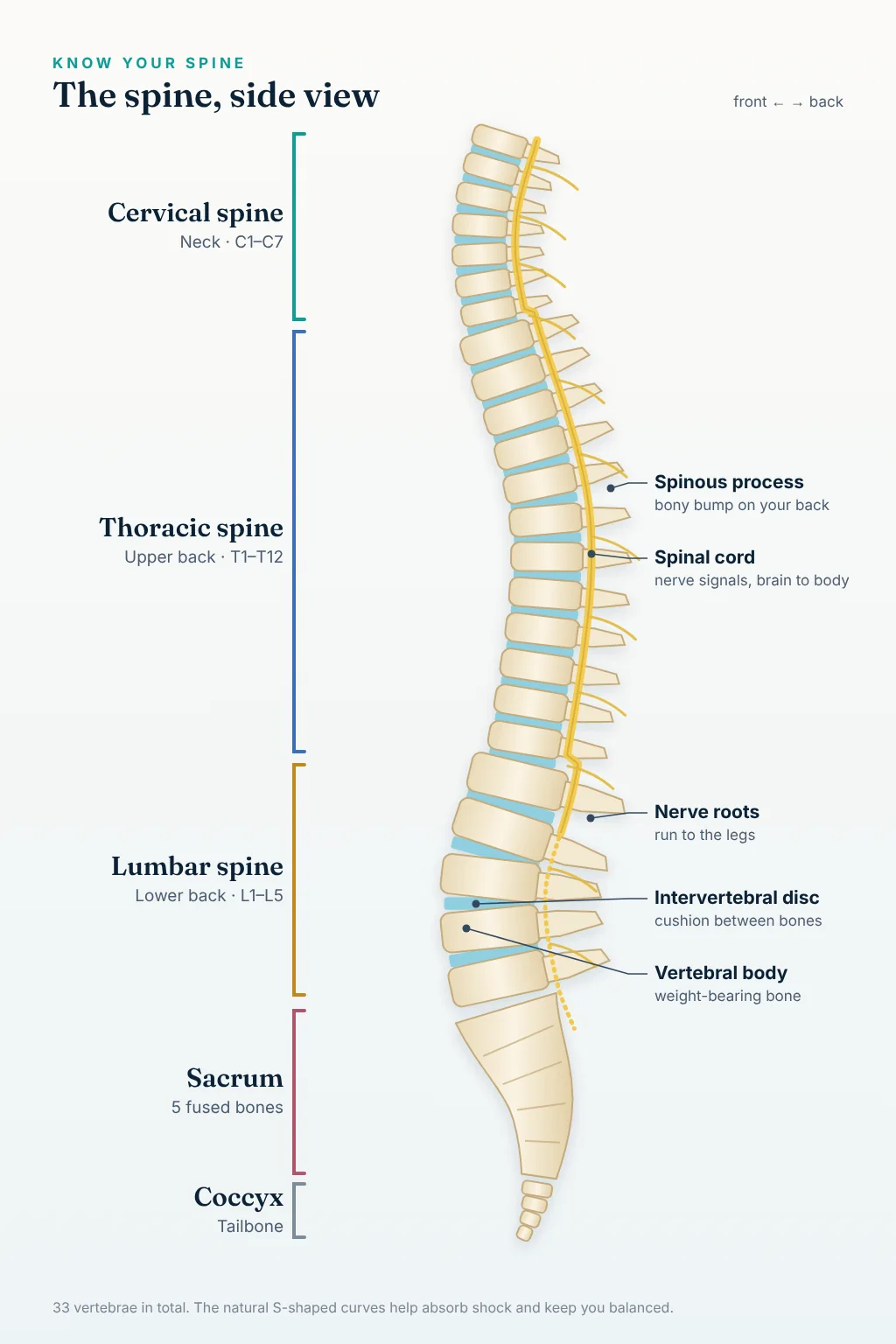 Enlarge the spine anatomy illustration
Explore the spine, region by region
Seen from the side, a healthy spine isn't straight. It curves gently into an "S" shape, which spreads your body weight evenly and absorbs shock with every step. Select a region to see what it does, which parts of the body its nerves serve, and the problems that commonly start there.
C1 – C7 · 7 vertebrae
Cervical spine Neck region
Seven vertebrae that support the head and give the neck its mobility. The top two, the Atlas and Axis, are what let you nod and turn your head. This region curves gently forward, a shape called lordosis.
Its nerves serve
The arms, hands and upper chest. Pressure on a nerve here can cause arm pain, tingling or a weak grip.
Common problems here
T1 – T12 · 12 vertebrae
Thoracic spine Upper & mid-back
Twelve vertebrae that anchor the rib cage, protecting the heart and lungs. This region curves gently backward, called kyphosis, and is naturally the least mobile part of the spine.
Its nerves serve
The chest and abdomen. The spinal cord also passes through here on its way to the legs.
Common problems here
L1 – L5 · 5 vertebrae
Lumbar spine Lower back
Five sturdy vertebrae that carry most of the body's weight and connect the spine to the pelvis. It's the most mobile weight-bearing region and, unsurprisingly, the most common site of back pain.
Some people naturally have four or six lumbar vertebrae instead of five. This is a normal anatomical variation, not a defect.
Its nerves serve
The legs, bladder and bowel. That's why nerve compression in the lower back can affect leg strength or bathroom control.
Common problems here
Sacrum & coccyx · fused bones
Sacrum & coccyx Base of the spine
Below the lumbar spine, the triangular sacrum links the spine to the pelvis for stability. At its very base sits the coccyx, the tailbone: a small cluster of fused bones that anchors several ligaments and muscles.
Nearby joints
The sacrum joins the pelvis at the two sacroiliac (SI) joints, a common and often missed source of low back and buttock pain.
Dr. Sharma explains your spine
Neck and back pain affect almost everyone at some point. In this short video Dr. Sharma walks through how the spine is built and why problems develop, so you know what to look out for and when to get it checked.
- How the vertebrae, discs and nerves work together
- Why neck and back pain are so common
- When it is worth seeing a spine specialist
The video plays from YouTube only after you press play.
What a spine is made of
The spine is built from small, ring-shaped bones called vertebrae, stacked one on top of the other with a cushioning disc between each pair. It does three jobs at once: it holds you upright, lets you bend and twist, and shields the spinal cord running through its centre.
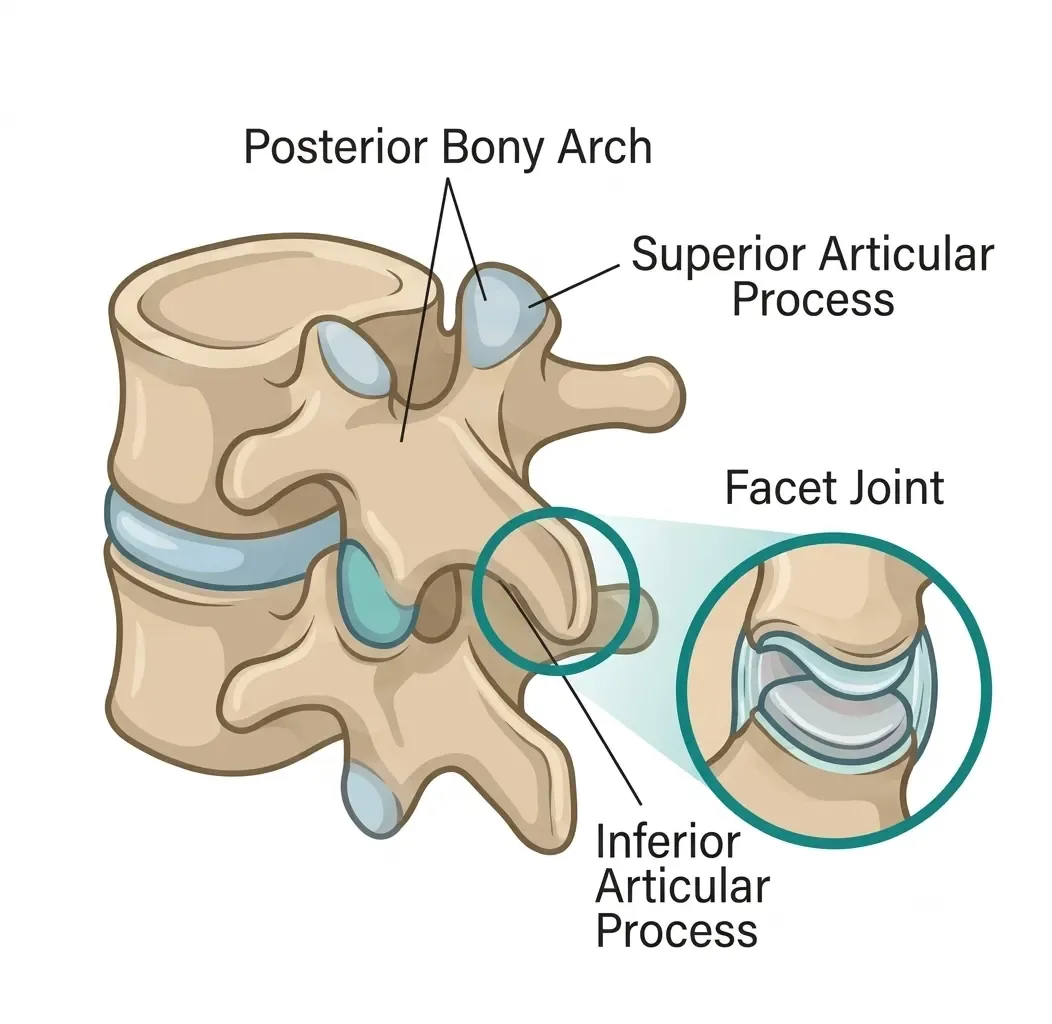 Enlarge: Close-up of a facet joint between two vertebrae
Vertebrae & facet joints
Each vertebra has a solid body at the front and a bony arch behind it that encloses the spinal canal. Neighbouring vertebrae connect through the disc at the front and small facet joints at the back. That's what allows controlled, guided movement rather than a floppy stack of bones.
When these joints wear: spondylosis · spondylolisthesis
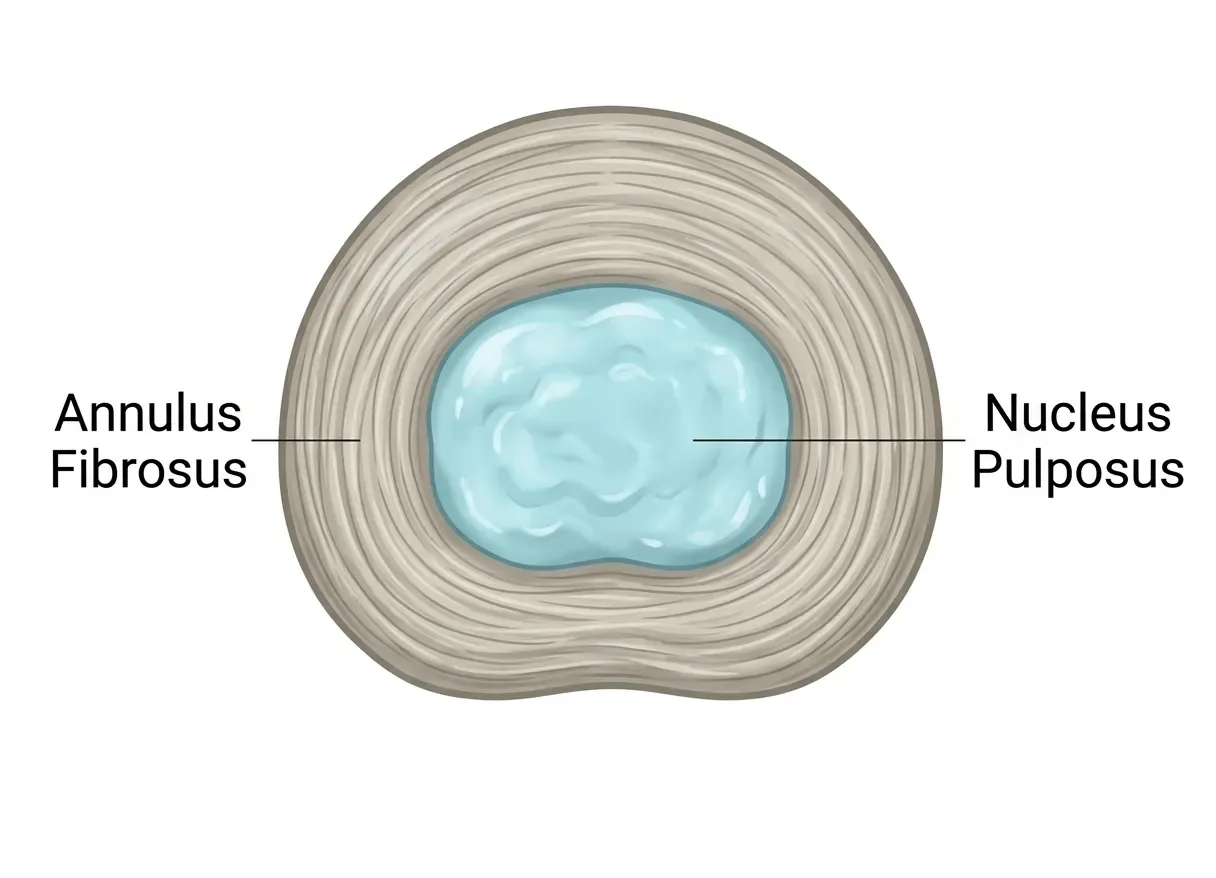 Enlarge: Disc cross-section: annulus fibrosus around the nucleus pulposus
Intervertebral discs
Each disc is a cushion between vertebrae, built from a tough outer ring (the annulus fibrosus) wrapped around a soft, gel-like core (the nucleus pulposus). When a disc herniates, that gel core pushes through a tear in the outer ring and can press on a nearby nerve. That's what causes shooting pain, numbness or weakness.
Read more: slip disc · how to read your MRI report
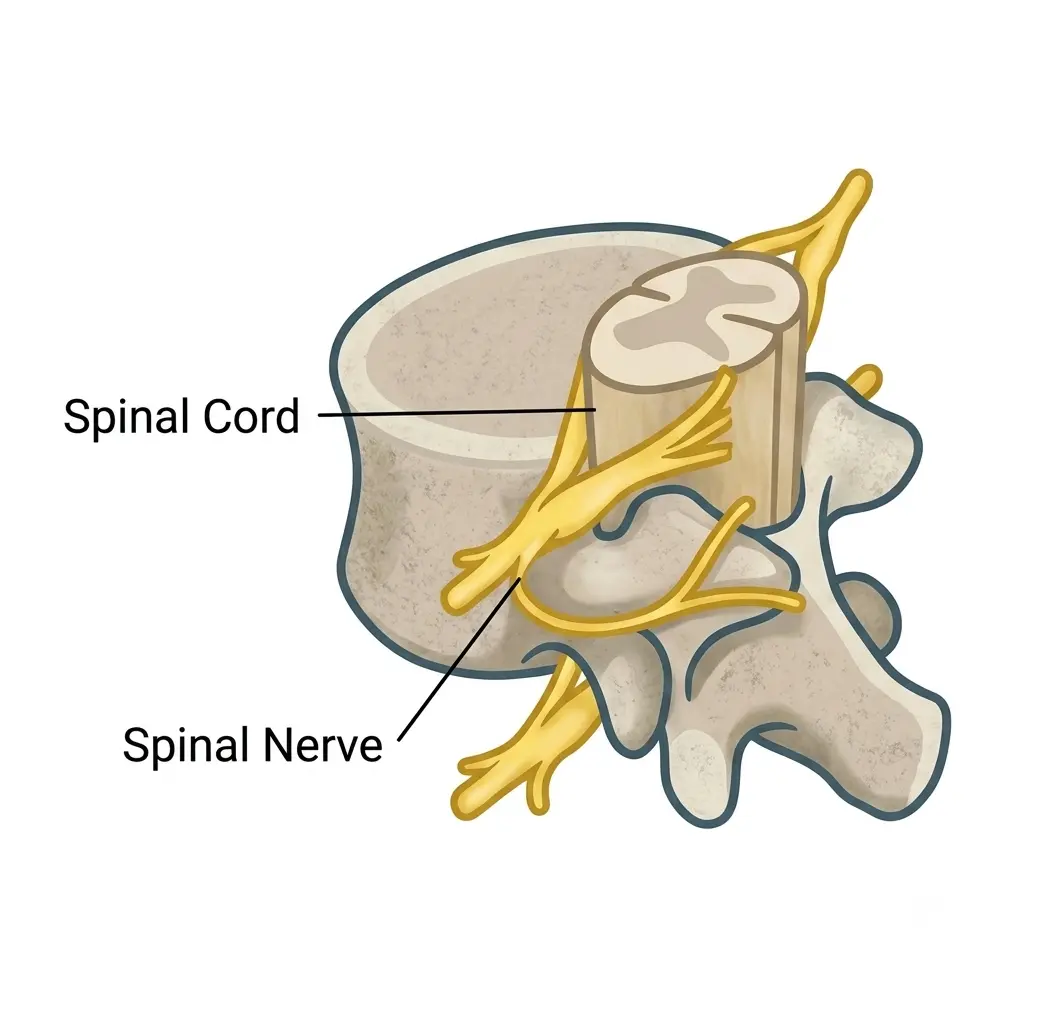 Enlarge: spinal segment with spinal cord and nerve
Spinal cord & nerves
The spinal cord is the main communication line between brain and body. It runs through the spinal canal and branches into 31 pairs of nerves. Cervical nerves serve the arms and upper chest, thoracic nerves the chest and abdomen, and lumbar nerves control the legs, bladder and bowel.
When nerves are squeezed: spinal stenosis · cervical myelopathy
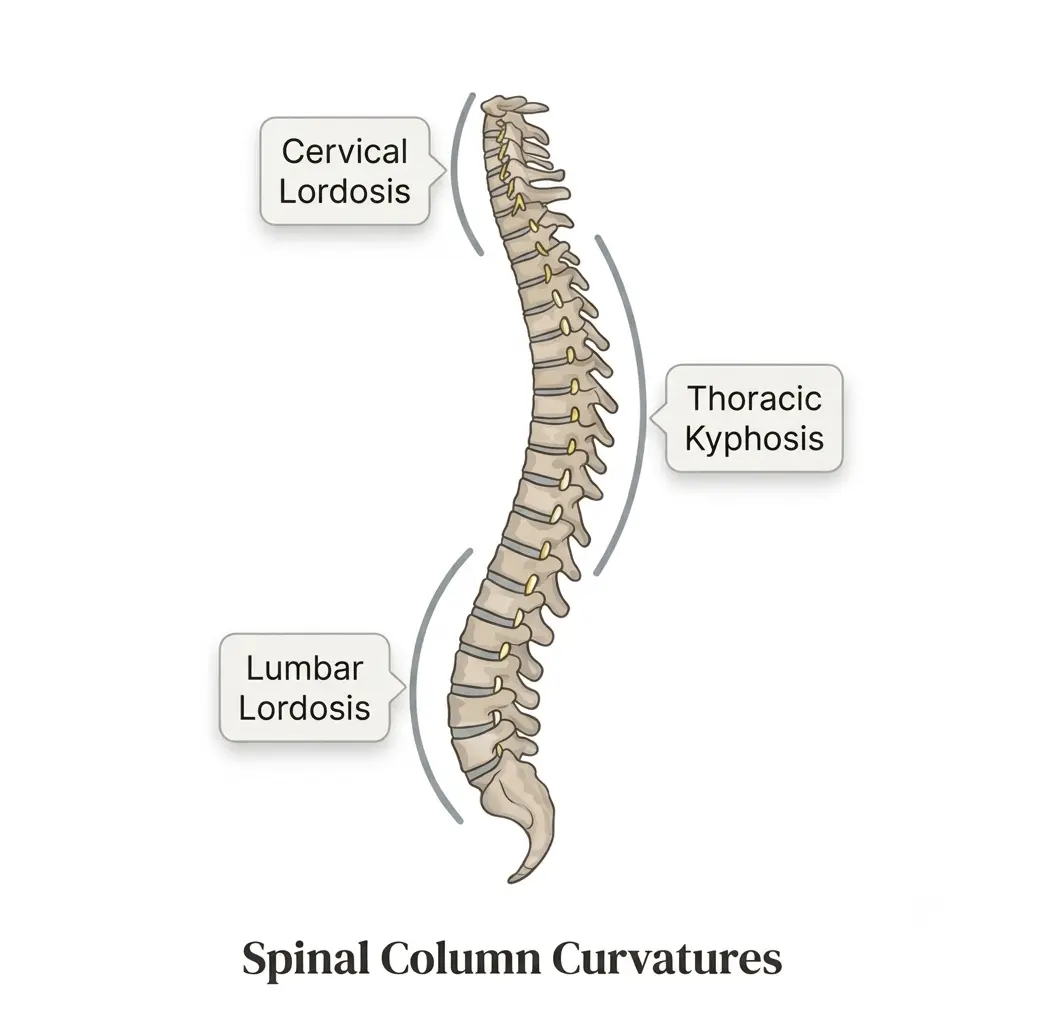 Enlarge: natural curves of the spine
The natural curves
A healthy spine curves gently into an "S" shape. That curve isn't a flaw, it's the design: it spreads your body weight evenly and absorbs shock with every step. That's why a spine can handle a lifetime of standing, walking and lifting.
When curves change: scoliosis · kyphosis · the normal spine in detail
Where do you feel it?
Pain often shows up away from where the problem is, because nerves carry it along their path. Choose where you feel symptoms to see the guides worth reading first.
Neck, shoulders or arms
Usually starts in the cervical spine. Arm tingling or a weak grip points to a nerve or the spinal cord.
Upper or mid-back
The thoracic spine. A new hump, loss of height or pain after a minor fall deserves a check.
Lower back, buttocks or legs
The lumbar spine. Pain shooting down the leg is often a pinched nerve (sciatica).
Seek urgent care for numbness in the groin or saddle area, new bladder or bowel problems, or rapidly worsening weakness in the arms or legs.