Minimally Invasive Spine Surgery (MISS) allows decompression, stabilization and instrumentation through smaller surgical corridors with less disruption to the muscles and surrounding soft tissues. The objective is the same as conventional surgery—relieve pressure, restore stability and protect neurological structures—but with less approach-related trauma in appropriately selected patients.
The principle behind MISS
The operation is not “smaller” in purpose. The same spinal problem is treated through a more tissue-preserving route using specialized visualization, imaging and instruments.
How MISS Differs From Conventional Spine Surgery
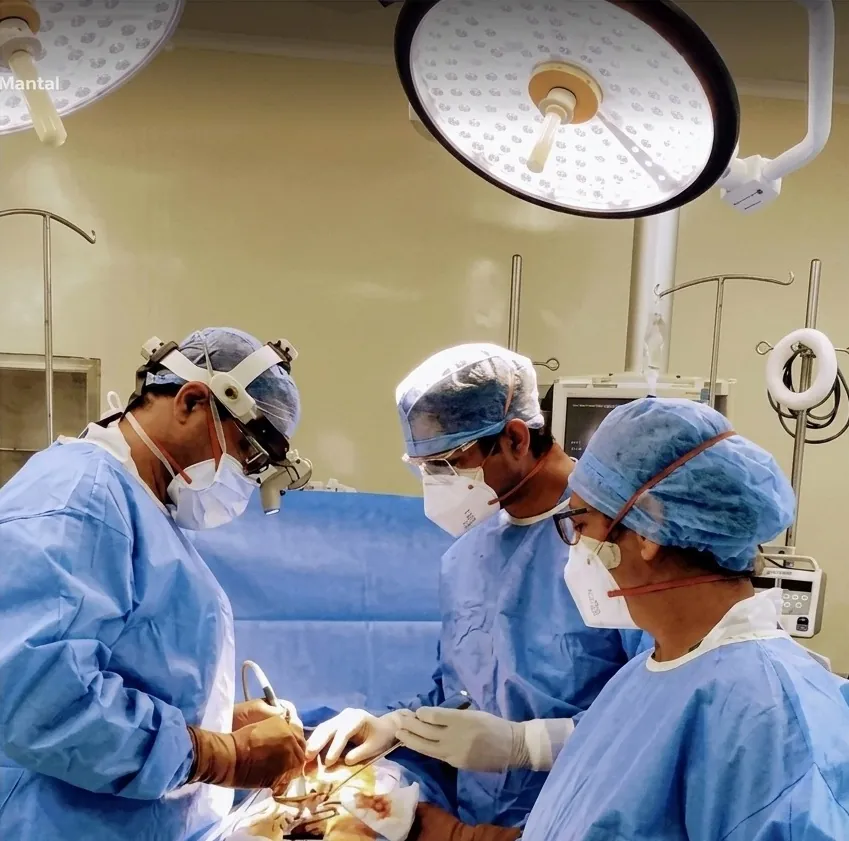
Traditional open surgery may require a longer incision and wider muscle exposure to reach the spine. MISS uses tubular retractors, endoscopes or microscopes to create a focused working corridor, often through incisions around 1–2 cm depending on the procedure.
| Feature | Conventional approach | Minimally invasive approach |
|---|---|---|
| Exposure | Wider muscle dissection may be required. | Muscles are separated or dilated through a focused corridor. |
| Blood loss | Can be greater with extensive exposure. | Usually reduced because less soft tissue is disturbed. |
| Postoperative recovery | May require a longer early recovery. | Often allows earlier mobilisation and shorter hospital stay. |
| Visualization | Direct open visualization. | Microscope, endoscope and image guidance provide magnified targeted views. |
Benefits of Minimally Invasive Spine Surgery
Recovery and comfort benefits
- Earlier mobilisation: many patients can stand or walk within hours and selected procedures allow discharge the same or following day.
- Less blood loss: smaller corridors and reduced muscle dissection usually limit operative blood loss.
- Less postoperative pain: reduced tissue injury can lower analgesic requirements.
- Earlier return to routine: return to work varies with the operation and occupation, but recovery is often quicker than after equivalent open exposure.
- Smaller scars: limited skin incisions generally provide a better cosmetic result.
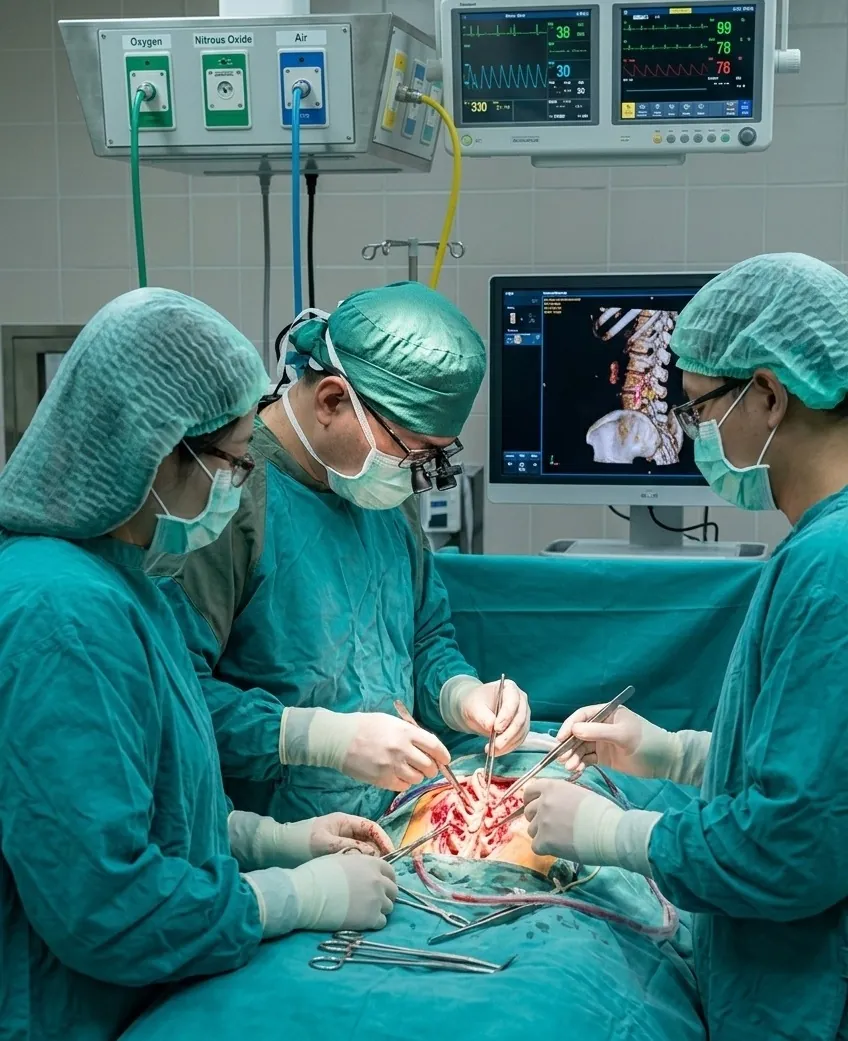
Modern visualization and guidance can also improve precision. High-definition endoscopy, surgical microscopes, C-arm or O-arm imaging, computer navigation and robotic guidance help the surgeon work accurately around nerves, the spinal cord and instrumentation.
Common Procedures Performed With MISS
Decompression and disc procedures
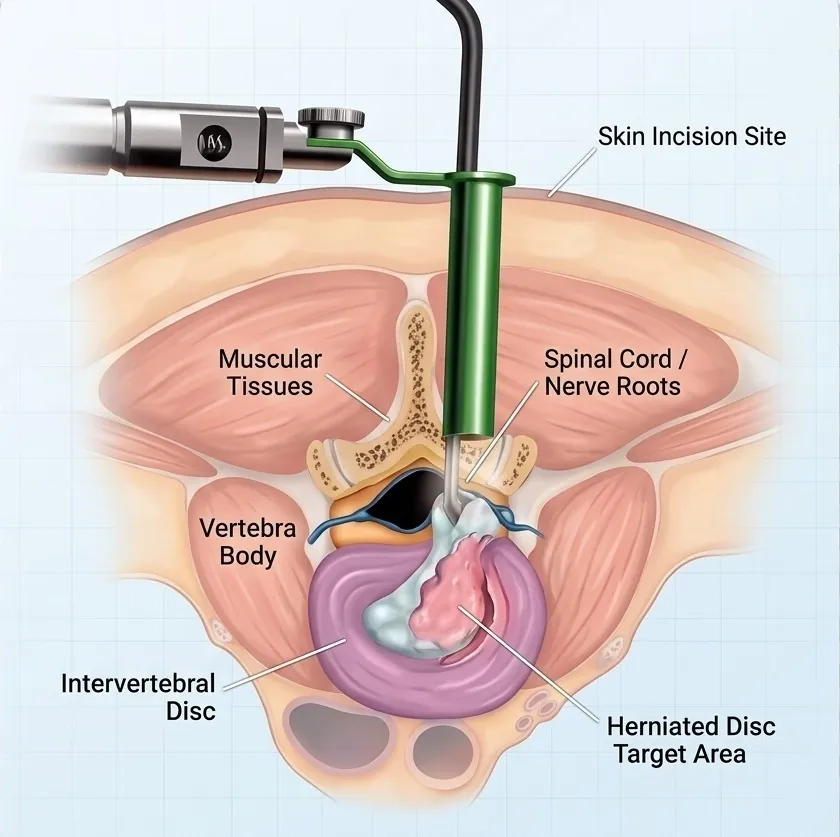
- Micro-endoscopic discectomy: a tubular retractor or endoscope is passed through a small incision to remove disc material compressing a nerve and producing sciatica or radiating limb pain.
- Minimally invasive lumbar decompression: selected bone, thickened ligament or disc material is removed to enlarge the space for neural structures in lumbar canal stenosis without requiring a wide laminectomy in suitable cases.
Fusion, instrumentation and fracture procedures
- Minimally invasive fusion: screws and rods can be placed through small skin openings using fluoroscopy, navigation or robotic guidance while muscles are dilated rather than widely stripped.
- Common indications include instability, spondylolisthesis, degenerative disc disease and selected revision cases, including older or osteoporotic patients.
- Vertebroplasty and kyphoplasty: selected painful osteoporotic vertebral fractures can be treated percutaneously with cement augmentation under image guidance.
Is Every Patient a Candidate?
No. The safest approach depends on the diagnosis, severity and location of compression or instability, age, bone quality, previous surgery and the surgeon's experience with the required technique. Some complex deformities or extensive pathology may still be better treated through a conventional or combined approach.
Technique follows the pathology
The goal is not to use the smallest incision at any cost. The correct operation is the one that achieves adequate decompression or stabilization safely.
Advanced Technology Used in MISS
- Tubular retractors and endoscopes create a narrow working channel.
- High-definition surgical microscopes magnify delicate anatomy.
- C-arm and O-arm imaging provide real-time or three-dimensional image guidance.
- Computer navigation helps plan and verify instrument trajectories.
- Robotic platforms can assist selected screw-placement workflows.
Final Thoughts
MISS has expanded the range of spine procedures that can be performed with limited tissue disruption—from disc decompression and stenosis surgery to fusion and selected fracture treatment. For the right patient, it can combine effective decompression or stabilization with less blood loss, earlier mobilisation and faster functional recovery.
The important decision is not whether a procedure carries the label “minimally invasive,” but whether the chosen technique safely addresses the exact spinal problem.
This article is general education written by Dr. Amit Sharma. It is not a diagnosis or a substitute for an in-person consultation.