Three spine terms that all start with "spondylo-" often land on the same MRI report and cause outsized panic, simply because they sound almost identical. They aren't the same condition at all — here's what actually separates them.
The Root Word
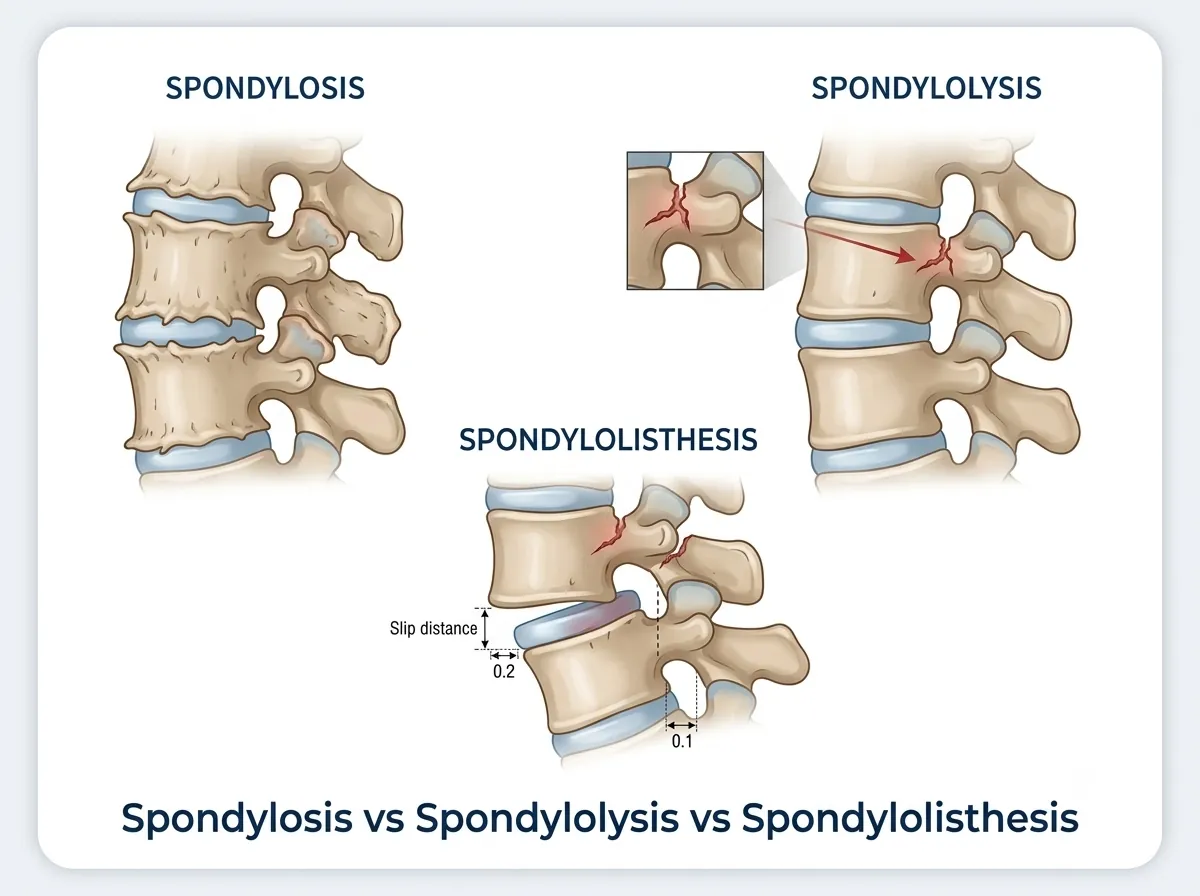
All three share the Greek root for vertebra. The ending tells you what's actually happening: -osis means wear or degeneration, -lysis means a fracture or defect, and -listhesis means slippage.
1. Spondylosis — Wear and Tear
General age-related degeneration of the spine, essentially arthritis of the spine. Can occur in the neck (most common), lower back, or upper back. By age 60, imaging shows some degree of spondylosis in the large majority of people — most without any symptoms. When it is symptomatic: morning stiffness, a dull ache that worsens with prolonged sitting or standing, and occasionally pain radiating into an arm or leg.
Treatment: Rarely surgical. Physiotherapy, posture correction, and lifestyle changes manage the large majority of cases; surgery is reserved for significant nerve compression that hasn't responded to conservative care.
2. Spondylolysis — A Stress Fracture
A defect or stress fracture in the pars interarticularis, a small bony bridge in the vertebra — almost always at L4 or L5, the lowest lumbar levels that bear the most load. Common in young athletes (gymnasts, fast bowlers, weightlifters, dancers) from repetitive hyperextension, and occasionally linked to a congenital weakness in the bone. Many cases are silent and found incidentally on an unrelated scan. When symptomatic: activity-related low back pain that eases with rest, worse with backward bending, usually without leg pain.
Treatment: Rest, physiotherapy, core strengthening, occasionally a brace. Surgery is rarely needed unless the fracture allows the vertebra to slip — which becomes spondylolisthesis.
3. Spondylolisthesis — A Vertebra Out of Place
One vertebra slides forward (or occasionally backward) over the one below it, graded from Grade I (under 25% slippage) to Grade IV (over 75%). The two most common types: isthmic, arising from an unresolved pars fracture and more common in younger patients, and degenerative, caused by worn discs and facet joints losing their grip on the vertebra, most common after 50.
Symptoms tend to be more pronounced than the other two conditions: low back and buttock pain, sciatica-type leg pain or numbness, symptoms that worsen with standing or walking and ease with sitting or bending forward, and in severe cases, difficulty walking longer distances.
Treatment: Grade I–II often responds well to physiotherapy and core strengthening. Grade III–IV, or any grade with significant nerve compression, usually benefits from decompression and stabilisation surgery.
Side-by-Side
| Feature | Spondylosis | Spondylolysis | Spondylolisthesis |
|---|---|---|---|
| What it is | Age-related wear | Stress fracture | Vertebra slips out of place |
| Who gets it | Adults 40+ | Young athletes | Adults of any age |
| Leg pain? | Sometimes | Rarely | Often |
| Usually needs surgery? | Rarely | Rarely | Sometimes — grade dependent |
Can One Lead to Another?
Yes, and it's clinically important. An unresolved pars fracture (spondylolysis) can gradually allow the vertebra to slip forward into isthmic spondylolisthesis. Separately, ongoing degeneration of the discs and facet joints (spondylosis) can eventually strip away enough stability to cause degenerative spondylolisthesis — the most common form in patients over 60. In short: the first two conditions are risk factors for the third, and managing them early lowers that risk.
When to See a Spine Surgeon
See a surgeon immediately
Loss of bladder/bowel control · sudden severe leg weakness · inability to walk
See a surgeon within weeks
Progressive weakness or foot drop · spreading numbness · leg pain worse than back pain
Book a routine assessment
Chronic pain with an unclear diagnosis · wanting a second opinion on your MRI
A large part of a first consultation is going through the MRI report line by line in plain language, because most patients arrive far more frightened than the findings actually warrant. A "spondylosis" label doesn't mean an operation is coming, and a Grade II spondylolisthesis doesn't mean paralysis is near. The approach stays the same: understand the condition fully, exhaust the right non-surgical options first, and recommend surgery only when it will clearly improve quality of life.
— Dr. Amit Sharma
Key Takeaways
- Spondylosis = wear and tear. Very common, usually manageable without surgery.
- Spondylolysis = a stress fracture in the vertebra, common in young athletes, rarely needs surgery.
- Spondylolisthesis = a slipped vertebra, may need surgery depending on grade and symptoms.
- The three exist on a spectrum — the first two can progress into the third if left unmanaged.
- An MRI report is not a verdict. Get a proper specialist opinion rather than relying on a search engine.
This article is general education written by Dr. Amit Sharma. It is not a diagnosis or a substitute for an in-person consultation.