What Is Cervical Myelopathy?
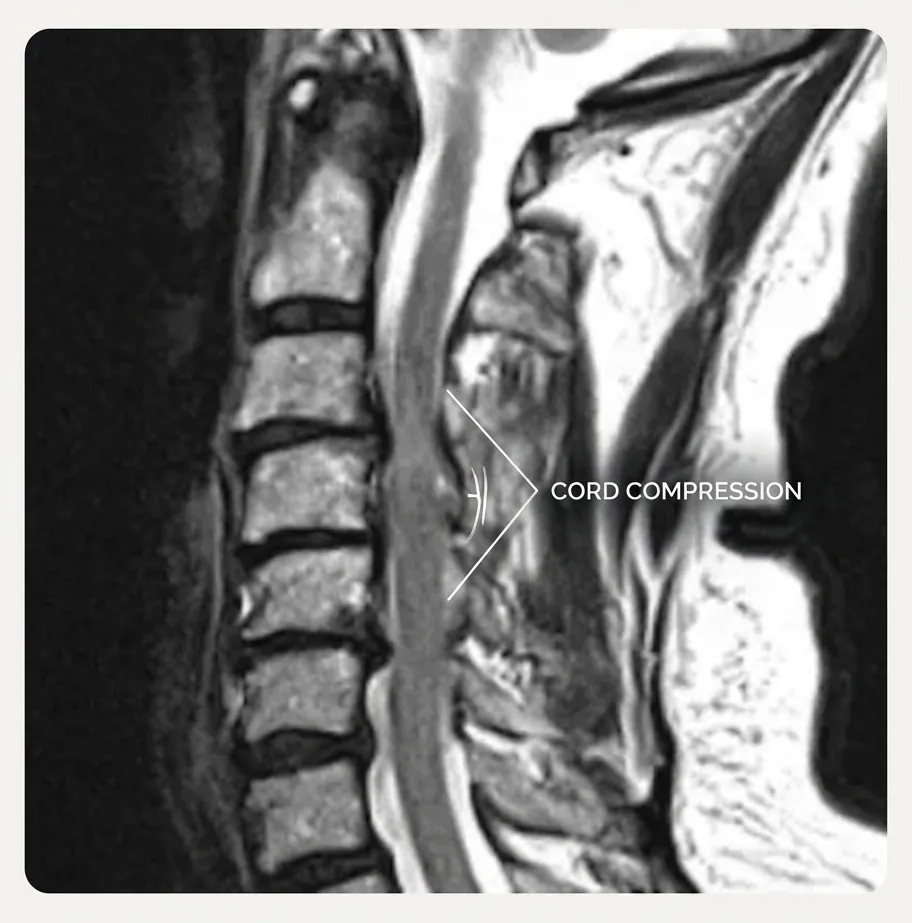
Cervical myelopathy is dysfunction of the spinal cord caused by compression in the neck. Unlike a single pinched nerve, spinal-cord compression can affect hand function, balance, walking and the legs together. Early changes may be subtle: buttons become harder to fasten, handwriting changes, objects are dropped or walking feels less steady.
Why it is different
Cervical myelopathy is primarily a spinal-cord problem, not simply a neck-pain problem. Neurological function and progression therefore guide treatment.
What Causes Cervical Myelopathy?
The commonest cause is cervical spondylosis. Disc bulging and height loss, osteophytes and thickened ligaments progressively reduce the space available for the cord. Some people also begin with a congenitally narrow canal.
| Cause | Effect |
|---|---|
| Cervical spondylosis | Disc, bone-spur and ligament changes narrow the canal. |
| Congenital stenosis | A naturally narrow canal leaves less reserve around the cord. |
| OPLL / ligament ossification | Ossified ligaments reduce canal diameter. |
| Disc herniation | A focal disc can directly indent the cord. |
| Fracture, infection or tumor | Structural displacement, abscess or mass can compress neural tissue. |
Symptoms and Diagnosis
Common symptoms include tingling or numbness in the hands, loss of grip, hand clumsiness, poor coordination, imbalance, difficulty walking, limb stiffness or spasticity, and bladder or bowel dysfunction in advanced disease.
Tests used to evaluate cervical myelopathy
- Neurological examination: strength, sensation, reflexes, dexterity, gait and cord signs.
- MRI: primary test for cord compression, discs, ligaments and cord changes.
- X-rays: alignment, degeneration and instability.
- CT: useful for ossified ligaments/bone or when MRI cannot be performed.
- EMG/NCV: helps when imaging and symptoms disagree or peripheral neuropathy is possible.
- Blood tests: selected evaluation for B12 deficiency, infection or tumor.
Why Timely Evaluation Matters
Spinal-cord compression may progress gradually, remain stable for a period or occasionally worsen quickly. Once significant neurological loss is established, decompression may stop further decline but cannot guarantee complete reversal.
Urgent
Rapidly worsening weakness, major gait deterioration or new bladder/bowel dysfunction.
Timely review
Increasing hand clumsiness, falls, worsening balance, numbness or weakness.
Monitoring
Mild stable symptoms still need follow-up so neurological change is recognized early.
Is Non-Surgical Care an Option?
Selected patients with mild, stable disease and no significant neurological progression may be monitored with activity modification, medication, supervised physiotherapy and close follow-up. These measures can help pain and mobility but do not physically remove significant cord compression.
Avoid forceful manipulation
With significant cord compression, aggressive or unsupervised high-force neck manipulation may be unsafe.
When Is Surgery Considered?
Surgery is considered for clinically meaningful myelopathy, progressive neurological deterioration, significant cord compression that matches symptoms, or instability/deformity threatening the cord. The main objective is to create adequate space for the spinal cord and prevent further injury.
Surgical Approaches
| Approach | Typical role |
|---|---|
| Anterior decompression / ACDF | Front-sided compression across one or a few levels. |
| Corpectomy | Broader anterior decompression behind a vertebral body. |
| Posterior laminectomy with fusion | Multilevel decompression with added stability when appropriate. |
| Laminoplasty | Motion-preserving posterior decompression in selected multilevel disease. |
| Combined surgery | Selected complex compression, deformity or instability. |
What determines the surgical route
- Front versus back location of compression.
- Number of affected levels.
- Cervical alignment and kyphosis.
- Instability and need for fusion.
- OPLL or complex bony compression.
- Previous surgery, bone quality and medical fitness.
Recovery and What Patients Should Expect
Recovery varies. Some patients notice early improvement in hand function, balance or limb symptoms; spinal-cord recovery in others occurs gradually over months. Longstanding numbness, weakness or gait difficulty may improve incompletely because surgery cannot reverse every established cord injury.
Rehabilitation focuses on safe mobilisation, walking, strength, balance and return to daily activity.
The realistic goal
For established myelopathy, success is often measured first by stopping further neurological decline. The amount of recovery depends partly on the severity and duration of cord injury before treatment.
This article is general education written by Dr. Amit Sharma. It is not a diagnosis or a substitute for an in-person consultation.