What Is Meralgia Paresthetica?
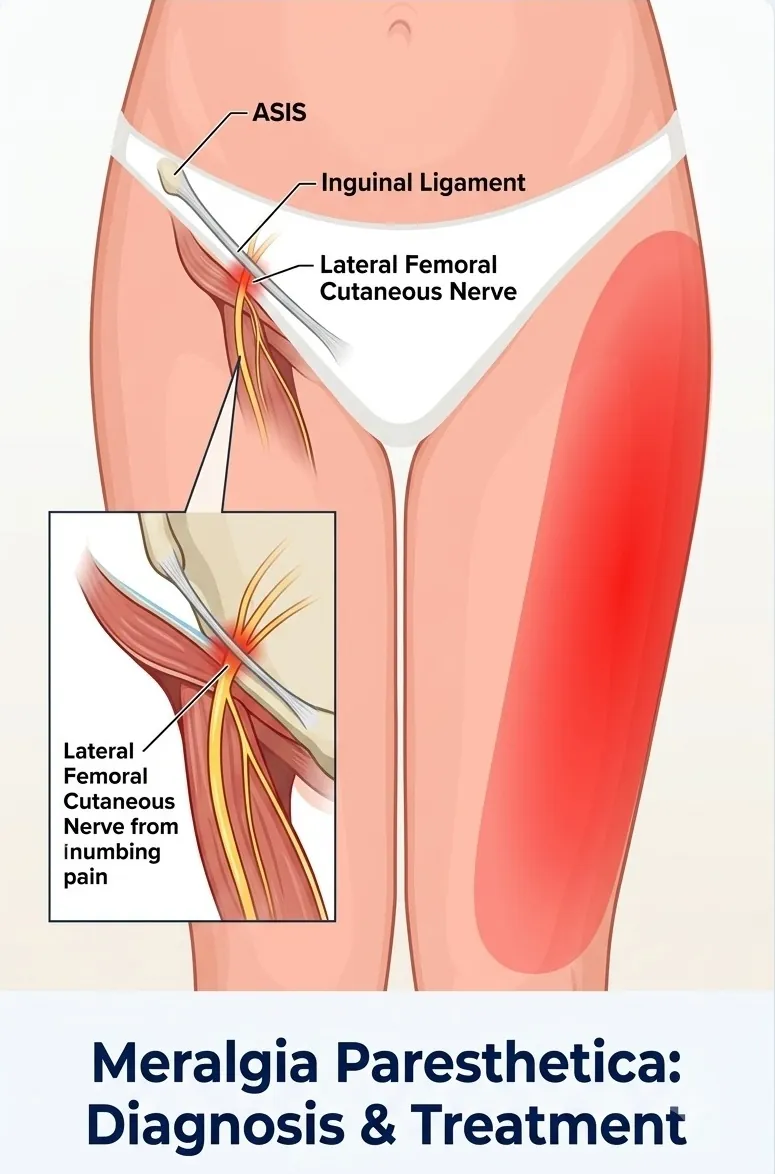
Meralgia paresthetica is irritation or compression of the lateral femoral cutaneous nerve (LFCN), usually where it travels through the groin near the inguinal ligament and the front of the pelvis. The LFCN supplies sensation to the front-outer thigh.
This nerve is sensory, not motor
Typical meralgia paresthetica causes burning, tingling or numbness without true muscle weakness. Objective weakness suggests another or additional diagnosis and should be evaluated.
Common Causes and Risk Factors
What can compress or irritate the LFCN?
- Tight jeans, belts, uniforms or equipment pressing across the groin.
- Obesity or increased abdominal/pelvic pressure.
- Pregnancy.
- Rapid weight change that alters cushioning around the nerve.
- Local trauma or injury near the hip/groin.
- Prolonged standing or walking in susceptible individuals.
- Diabetes and other factors that increase susceptibility to peripheral nerve problems.
Symptoms
- Burning discomfort over the front-outer thigh.
- Tingling, pins-and-needles or numbness.
- Unusual sensitivity to light touch, including irritation from clothing.
- Symptoms usually affect one side and remain within the sensory territory of the LFCN.
- Standing, prolonged walking, tight waistwear or hip extension may aggravate symptoms.
How Meralgia Paresthetica Is Diagnosed
| Assessment | Purpose |
|---|---|
| History and examination | Maps the sensory area, looks for groin-level provocation and checks whether strength/reflex findings point elsewhere. |
| Diagnostic LFCN block | Temporary improvement after accurately placed local anesthetic supports the LFCN as the pain source and may also provide relief. |
| EMG / nerve-conduction testing | Can support peripheral nerve involvement and help distinguish other neuropathies or upper-lumbar nerve-root disease, although technical sensitivity varies. |
| Lumbar MRI | Used when the presentation is atypical or spinal causes such as upper-lumbar disc disease or stenosis need exclusion. |
Not every numb thigh comes from the LFCN
Back pain, reflex change, true weakness or symptoms extending outside the classic front-outer thigh distribution can point toward lumbar nerve-root or another neurological pathology.
Treatment Options
Conservative treatment
- Remove tight belts, waistbands or clothing that compresses the groin.
- Weight reduction when excess weight is contributing to compression.
- Posture and ergonomic modification and reducing repeatedly provocative activity.
- Medication for neuropathic pain may be prescribed when symptoms are persistent.
- Physiotherapy can address hip/pelvic mechanics, soft-tissue tightness and movement factors.
Injections and surgery
- Nerve block: local anesthetic, sometimes combined with anti-inflammatory medication, can provide diagnostic information and symptom relief.
- Surgical decompression: rarely required, but persistent disabling symptoms despite appropriate conservative care may justify releasing the nerve from compression.
- Other operative strategies: are reserved for carefully selected refractory cases because the LFCN is purely sensory and surgery can alter sensation.
When to Consult a Spine or Nerve Specialist
Prompt neurological assessment
New true leg weakness, bladder/bowel disturbance or rapidly progressive neurological symptoms are not typical meralgia paresthetica and need urgent evaluation.
Arrange a review
Persistent burning/numbness, severe pain, an uncertain diagnosis or failure of simple pressure-relieving measures warrants specialist assessment.
Often manageable conservatively
When symptoms clearly follow the LFCN distribution and a reversible compression factor is found, removing that pressure is usually the first step.
This article is general education written by Dr. Amit Sharma. It is not a diagnosis or a substitute for an in-person consultation.